
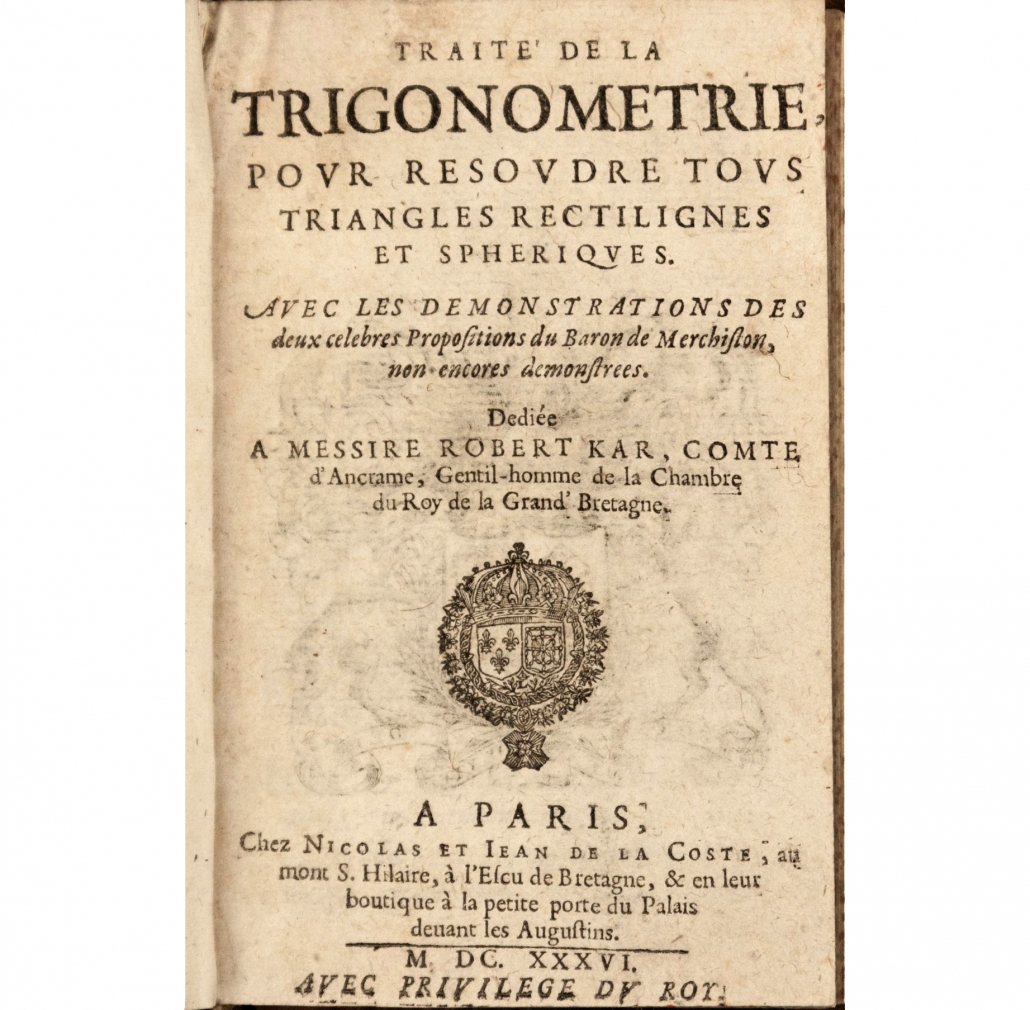
Knowledge, I have an image of it, all in all very banal: a boy on the way to school. Yes, but which boy, which way, and which school! In reality, it is an image that is anything but banal. An extraordinary image – literally it is beyond the ordinary – which says everything about knowledge.
This boy, he walks a fast and flexible gait. He used to it, only stops walking to run. He is barefoot, and his shoes, rather his tatans, are tied by a string across his shoulder. Around him there is no one. An immensity of red laterite populated by a few shrubs here and there. In front of him, an endless track, a track from Africa. He walks a good pace which he’ll have to keep for a long time, hours, for days on end: his school is days ahead of him.
He is taking a good step towards what will bring him another life, knowledge. He has already met it, I don’t know how, because he preciously holds it in his arms and will never let go of it throughout his long walk: a book, to be exact, a treatise on trigonometry.
A lone boy in the African bush, a trigonometry treatise under his arm. You will grant me that this image is at the least unusual, but lived. How did he come to obtain this book? Why trigonometry? What does he know about trigonometry? What will he do with it? Never mind all that. To this boy, this book, whether it is trigonometry or another, it is knowledge, it is another life which his long and flexible steps lead to. Trigonometry, geography, reading, writing, all this and many other matters carry the same name, knowledge.
Quoting Erick Orsenna with another example: “Imagine you’re a school boy in Fava. Waking up at 4 in the morning, leaving at 5. A bus will pick you up at 6:30 at the Roura bridge. It takes an hour on the road. The return home is in the same manner. In the French Guiana the acquisition of knowledge is an adventure of valiance and obstinacy” (1).
Let’s leave these schoolchildren and go after a different image, a virtual image this time. I am referring to Maxwell’s demon, you know this demon who disputes the indisputable, the second principle of thermodynamics. What is it? Countless internet pages are dedicated to it, but they are either too complex or too confusing. I will therefore try to put it as simply as possible.
Let’s take an enclosure that contains two compartments separated by a partition, which has a hole in it. Let’s introduce a gas in one of the compartments. The second principle, or Carnot’s principle, introduces the notion of entropy, usually associated with disorder, which can only grow. But we do not need Mr. Sadi Carnot – whose memory I salute – to know that the gas will pass through the hole in the partition, so it will be equally distributed between both compartments. So, we have passed from an organized state, with the gas in one compartment, to an unorganized state, in which the gas is uniformly distributed.
I forgot: the hole in the partition can be closed by a door that can be moved without any effort, therefore without consuming any energy – a foolish mistake, but going on. This is where James Clerk Maxwells demon appears: this demon has piercing sight and, when he sees a single molecule of gas beginning to pass into another compartment, it closes the door. The result, the gas remains in the first compartment. Therefore our system remains organized in contradiction, with the famous principle.
In other words, Maxwell’s demon puts the second principle of thermodynamics at fault.
From there, billions of gray cells in thousands of brains enter into a bubbling state. This principle is inviolable, how can this demon, no matter how demonic it is, be able to violate it? Many ‘solutions’, each more absurd that the other have been formulated.
If I believe the internet – Définition | Démon de Maxwell | Futura Sciences (futura-sciences.com) – the pope of the domain, the Hungarian Léo Szilard tells that to observe the molecules, the demon will nedd to expend energy by illuminating them. We thus learn that our demon is provided with eyes and that is illumitaes the scene, bringing energy, which therefore changes the data of the problem, Carnot’s principle no longer applies.
Let’s forget about this absurd lighting and admit that our demon can close the port without efforts, therefore without expending any energy, and that is to prohibit the passage of a gas molecule (we have the right to do so because it is only a concept). I will thereofre be possible to maintain that gas in a single compartment without bringing or consuming energy, in other words, without disturbing the system,
Let’s see, let’s think. If the demon is capable of closing the door at an opportune moment, it means on thing: it knows. It KNOWS that is must close the door when a molecule is present at the passage: The demon does ot bring any energy, but it brings INFORMATION, which is equivalent. In other terms, information equals energy, knowledge is a form of energy. QED.
You don’t say anything, but I perceive your objection: all of this is purely conceptual, so it comes down to the dreams of a walker, solitary or not. In reality, the equivalence of energy and information is concretely demonstrated. Alexia Auffèves from the Louis Néel Institute, in Grenoble, demonstrated that it is possible to extract energy from a system simply by measuring it. This clearly establishes a relationship between energy and knowledge (2). It is not simple, and I personally admit that I am reaching my limits of incompetence, but let’s trust the Grenoble researchers.
In short, KNOWLEDGE IS FORM OF ENERGY.
We are told there are six forms of energy: mechanical, gravitational, thermal, radiative (or luminous), chemical, electrical, nuclear (3). Two more must be addeed: matter (4) and, as we have seen, knowledge.
- Erik Orsenna, La terre a soif, Fayard
- DOI: 1038/d41586-017-01312-3 (Cf Nature, 2017, 547 (7662) :142.)
- Different forms of energy : mechanic, gravitational, thermal… | Choisir.com
- science-sapience.fr/matiere-egale-energie (matter is energy)


Leave a Reply
Want to join the discussion?Feel free to contribute!